
 0/12
 0/12
09 Plants vs. Zombies
Today’s Goal
Section titled “Today’s Goal”Make a tower defence game, like Plants vs. Zombies: goblins march across a field towards your castle, one row each. Set out chests that pay gold, and spend the gold on defenders that stop the goblins.
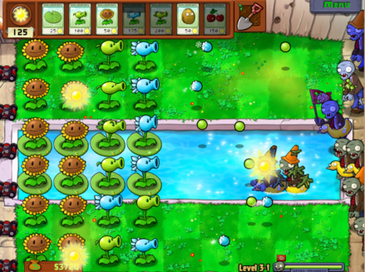
The original has many kinds of plants and zombies, and they mix and match abilities. Ours moves that idea to a castle. One defender shoots, another earns gold, another just blocks, and a goblin may carry a wooden or an iron shield. In Zelda we asked whether something should be a subclass or a part. Here we build every game object from parts, with the Component pattern.
The defender and goblin types come from data files, with the Type Object pattern. And since the game is played with the mouse, we start with picking, which turns a click into a card or a cell on the field.
Source code: gar-games/09-plants-vs-zombies
Prepare
Section titled “Prepare”- Component
- Type Object
- Optional: Evolve Your Hierarchy (Mick West), the article that made the case for components in games
Picking
Section titled “Picking”Step Pvz0
Picking is finding out what the player clicked on. It takes two steps.
First, from the window to the game. The mouse position is in window pixels, but the game draws at its virtual resolution (1280 × 720), scaled and centred in the window (Flappy Bird). So the mouse position goes through the screen scale matrix backwards:
private Vector2 MousePosition(){ Viewport viewport = GraphicsDevice.Viewport; Vector2 mouse = Input.Mouse.Position.ToVector2() - new Vector2(viewport.X, viewport.Y); return Vector2.Transform(mouse, Matrix.Invert(ScreenScaleMatrix));}Then, from a point to a thing. For a grid, that’s a division, as in the tilemaps of Mario:
public static Point? CellAt(Vector2 position){ if (!Bounds.Contains(position)) return null; return new Point((int)(position.X - Bounds.X) / CellWidth, (int)(position.Y - Bounds.Y) / CellHeight);}For a few things that aren’t on a grid, like the cards or a coin, check each one: is the point inside its rectangle, or within its radius? When things overlap, the order of the checks decides what the click hits. Here, a coin floating over the field is checked first, then the cards, and only then the field.
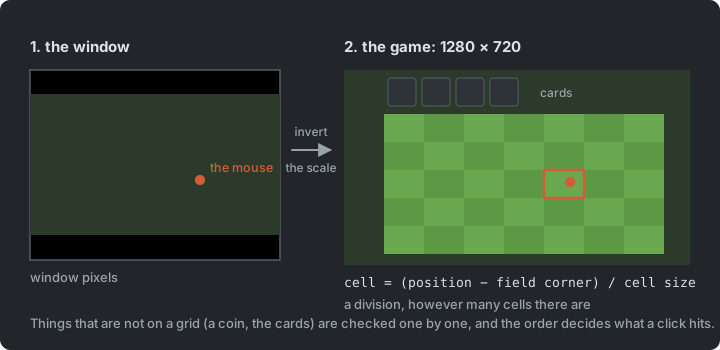
The cell under the mouse is highlighted, with a faint copy of the chosen defender, so the player sees what a click will do.
Try it (Pvz0): show the cell under the mouse in the window title. What does
CellAt give you off the field?
Defenders and Goblins, With Inheritance
Section titled “Defenders and Goblins, With Inheritance”Step Pvz1
Pvz1 is a working game, built the way you might start, with a class per kind of thing.
classDiagram
    class Defender {
        <<abstract>>
        +Point Cell
        +float Health
        +TakeDamage(damage)
        +Update(deltaSeconds, world)
        +Draw(spriteBatch)
    }
    class Goblin {
        +float Health
        +TakeDamage(damage)
        +Update(deltaSeconds, world)
        +Draw(spriteBatch)
    }
    Defender <|-- Chest
    Defender <|-- Archer
    Defender <|-- Knight
    class World {
        -Defender[,] defenders
        -List~Goblin~ goblins
        -List~Arrow~ arrows
        -List~Coin~ coins
    }
It works, but try adding more kinds:
- A Wizard shoots two arrows instead of one. A subclass of
Archerthat overrides something? ThenArcherneeds a way to be overridden that it didn’t need before. - A Shieldbearer is a goblin with a shield that takes the first hits. A subclass of
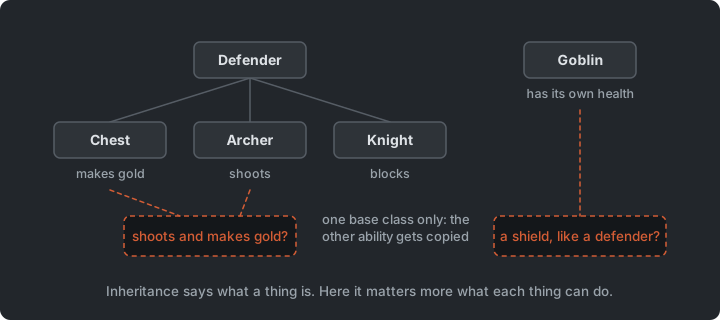
Goblin, fine. But a defender with a shield of its own needs the same thing, and a defender isn’t a goblin. - A defender that shoots and makes gold. Should it inherit from
Archeror fromChest? C# allows one base class. Whichever you choose, the other ability gets copied. - Health is already copied.
Goblinhas its ownHealth,TakeDamageand drawing, because a goblin isn’t a defender. Arrows and coins need their own lists inWorld, because they’re different classes too.
Inheritance describes what something is. In this game, what each thing can do matters more, and the abilities combine freely.
Try it (Pvz1): make a Wizard, an Archer that shoots two arrows, as a subclass. How
far do you get before Archer has to change?
The Component Pattern
Section titled “The Component Pattern”Step Pvz2
Allow a single entity to span multiple domains without coupling the domains to each other. (Game Programming Patterns)
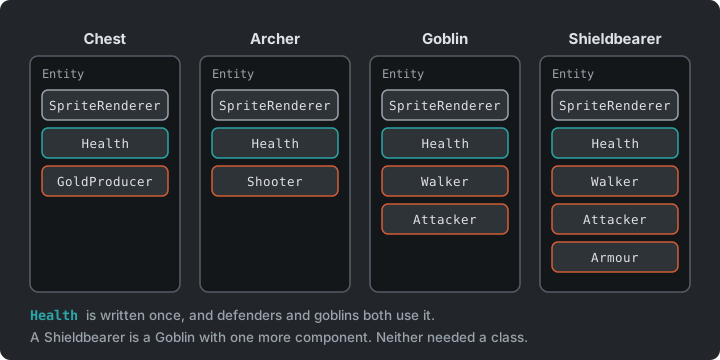
An entity is just a container, holding a position, a row, and a list of
components. Each component is one ability, such as Health, Shooter, GoldProducer, Walker, Attacker,
Armour, SpriteRenderer. An entity does what its components do.
public class Entity(World world){    private readonly List<Component> _components = [];
    public Vector2 Position { get; set; }    public int Row { get; set; }
    public Entity With(Component component) { ... }    public T Get<T>() where T : Component { ... }
    public void Update(float deltaSeconds)    {        foreach (Component component in _components)            component.Update(deltaSeconds);    }}
classDiagram
class Entity {
+Vector2 Position
+int Row
+With(component) Entity
+Get~T~() T
+Update(deltaSeconds)
+Draw(spriteBatch)
}
class Component {
<<abstract>>
+Entity Owner
+Update(deltaSeconds)
+Draw(spriteBatch)
}
Entity o-- Component
Component <|-- SpriteRenderer
Component <|-- Health
Component <|-- Armour
Component <|-- Shooter
Component <|-- GoldProducer
Component <|-- Walker
Component <|-- Attacker
Component <|-- Projectile
Component <|-- Collectible
There are no classes for defenders or goblins any more. Each kind of thing is a recipe, a list of components.
public Entity Chest(World world) => Defender(world, "chest", 6).With(new GoldProducer(9, 25));public Entity Archer(World world) => Defender(world, "archer", 6).With(new Shooter(1.4f, 1, 1));public Entity Wizard(World world) => Defender(world, "wizard", 6).With(new Shooter(1.4f, 2, 1));
public Entity Goblin(World world)    => new Entity(world)        .With(new SpriteRenderer(atlas.GetRegion("goblin")))        .With(new Health(10))        .With(new Walker(28))        .With(new Attacker(1));
public Entity Shieldbearer(World world) => Goblin(world).With(new Armour(18, atlas.GetRegion("wooden-shield")));
The Wizard and the Shieldbearer are new in Pvz2, and neither needed a class. A defender that
shoots and makes gold is .With(new Shooter(...)).With(new GoldProducer(...)). Health is
written once, and used by defenders and goblins alike.
Try it (Pvz2): add a recipe for a defender that shoots and makes gold, and give it a
card in Game1. How much new code did it take?
How components work together
Section titled “How components work together”Components are small and separate, but an entity’s parts still need each other:
-
Through the owner. A component can ask its entity for another component.
Walkerstops while theAttackeris attacking;Healthlets theArmourtake the damage first; theSpriteRendererflashes red whenHealthwas just hit.Walker.cs public override void Update(float deltaSeconds){if (Owner.Get<Attacker>()?.IsAttacking == true)return;Owner.Position -= new Vector2(speed * deltaSeconds, 0);} -
Through the world. A component can ask the world about other entities.
Shooterasks whether there’s a goblin ahead in its row;Attackerasks which defender is in front of it.
A component only depends on the components it uses. It doesn’t care what kind of entity
it’s in. Walker works on any entity; if the entity has no Attacker, it just keeps walking.
The world got simpler too. It doesn’t know what an archer or a coin is. One loop updates every entity, and one loop draws them. It keeps defenders, goblins and everything else apart only so that components can ask it questions (“the first goblin ahead in row 2”).
What components cost
Section titled “What components cost”- Finding each other takes code.
Owner.Get<Attacker>()looks through a list, and returnsnullif there’s no attacker. With inheritance, the compiler would have known. - Order matters. Components update and draw in the order they were added. The
Armouris drawn after theSpriteRenderer, so the shield is drawn over the goblin. - Where does a rule go? “An arrow damages the first goblin it reaches” could be in the
arrow (
Projectile) or in the goblin. Rules that span many entities get harder to place; in Geometry Wars, we’ll move some of them into systems.
Testing a component
Section titled “Testing a component”Project Pvz.Tests
A component that does one job can be tested on its own. A test builds an entity with only the parts it needs. It doesn’t need the field, the textures or a running game, just as the rules in Sokoban were tested without a window:
[Fact]public void Armour_takes_the_damage_first_and_passes_on_the_rest(){    var shieldbearer = new Entity(null);    Armour shield = shieldbearer.Add(new Armour(5, null));    Health health = shieldbearer.Add(new Health(10));
    health.Damage(8);
    Assert.False(shield.IsIntact);    Assert.Equal(7, health.Current);}
The world is null because neither component uses it. With a class per goblin, the same
test would need a ShieldbearerGoblin, and everything its base classes need.
Try it (Pvz.Tests): add a test for a goblin with armour 20 and health 10. Is it still
standing after two hits of 12? Run dotnet test.
Type Object
Section titled “Type Object”Step Pvz3
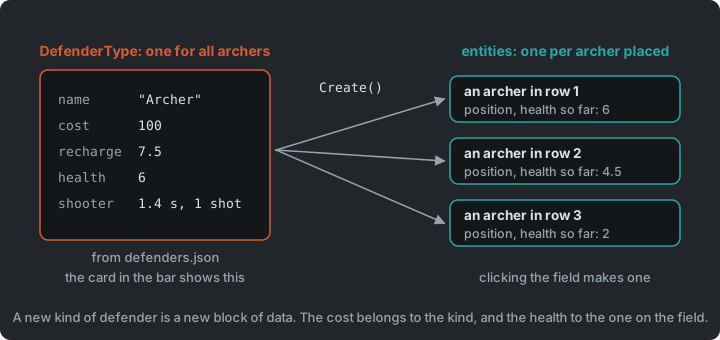
The recipes are still C#. Every defender type also has data that doesn’t belong in any one defender: its cost, how long its card takes to recharge, its sprite. An archer’s cost doesn’t fit in a component, because the archer on the field has no cost. Only its kind has one.
Allow the flexible creation of new “classes” by creating a single class, each instance of which represents a different type of object. (Game Programming Patterns)
A DefenderType object represents one kind of defender. There’s one DefenderType for all
chests, loaded from defenders.json:
{ "name": "Chest", "sprite": "chest", "cost": 50, "recharge": 7.5, "health": 6, "goldProducer": { "interval": 9, "amount": 25 } },{ "name": "Wizard", "sprite": "wizard", "cost": 200, "recharge": 7.5, "health": 6, "shooter": { "interval": 1.4, "shots": 2, "damage": 1 } }And the type builds its own instances, adding a component for each kind of data it has:
public class DefenderType{    public string Name { get; init; }    public int Cost { get; init; }    public float Recharge { get; init; }    public ShooterData Shooter { get; init; }    public GoldProducerData GoldProducer { get; init; }    // ...
    public Entity Create(World world)    {        var defender = new Entity(world)            .With(new SpriteRenderer(world.Atlas.GetRegion(Sprite)))            .With(new Health(Health));
if (Shooter != null) defender.Add(new Shooter(Shooter.Interval, Shooter.Shots, Shooter.Damage)); if (GoldProducer != null) defender.Add(new GoldProducer(GoldProducer.Interval, GoldProducer.Amount)); return defender; }}- Types and instances. The
DefenderTypeholds what all chests share; each entity on the field holds what’s its own (its position, its health so far). A card shows a type; clicking the field creates an instance. - New kinds without code. A new defender made from existing components is a new block in
defenders.json. An Ironclad is a goblin type with"armour": { "sprite": "iron-shield", "health": 55 }. A designer can balance the game (costs, health, timings) without compiling anything. - New abilities with a little code. The Bomb explodes, which no component did.
It took one new component (
Explode), one new property onDefenderType, and the data. Components and Type Object work together. Components are the building blocks, and the types are the data that combines them.
Try it (Pvz3): in defenders.json, make a Knight that costs 25 with twice the health,
and a Chest that makes 50 gold. Did you compile anything?
Prototype vs. Type Object
Section titled “Prototype vs. Type Object”In Angry Birds, prefabs also gave us many kinds of things without a class for each. The two patterns solve that problem in different ways:
| Prototype (Angry Birds) | Type Object (here) | |
|---|---|---|
| A kind of thing is… | a configured object of the same class | an object of a separate type class |
| A new thing is made by… | copying the prototype | the type creating an instance |
| Shared data (cost, recharge) | copied into every clone | kept once, in the type |
| An instance knows its kind? | not unless you store it | yes: it can refer to its type |
| Good for | “make more like this one” | kinds with their own data and rules |
A Level From Data
Section titled “A Level From Data”Step Pvz4
Pvz4 reads a level from level1.json: the starting gold, how often gold falls from the
sky, and which goblin comes when. Cards recharge after use, and game states
(Flappy Bird) end the game when a goblin reaches the
castle, or when every goblin is gone.
{ "startingGold": 150, "skyGoldInterval": 7, "spawns": [ { "time": 6, "goblin": "Goblin" }, { "time": 14, "goblin": "Goblin" }, ... ]}The falling coin is a coin with one more component, Faller. With components in place, many
new features take a single new component.
The Whole Game
Section titled “The Whole Game”Step Pvz4
Pvz4 is the finished game. Game1 holds the world, the card bar and the level, and sends
the level’s goblins into the world as time passes.
classDiagram
    Core <|-- Game1
    Game1 --> StateMachine : game states
    Game1 --> World
    Game1 --> CardBar
    Game1 --> Level
    World --> Entity : defenders, goblins and the rest
    Entity o-- Component
    CardBar --> DefenderType : a card for each
    DefenderType ..> Entity : creates
    GoblinType ..> Entity : creates
    Level ..> GoblinType : names
There is no class for an archer or a goblin anywhere in it. The types create entities, and the world only sees entities.
Summary
Section titled “Summary”| Concern | Answer |
|---|---|
| What the player clicked | Picking, from the window to the game to a cell |
| What a thing can do | Components |
| How the parts of one entity work together | Through their owner, and through the world |
| What every defender of a kind shares | Type Object, loaded from JSON |
| A new kind of thing | Data, plus one component for a new ability |
| Checking one ability | A test with only the parts it needs |
Exercises
Section titled “Exercises”Start from Pvz4. The art for the exercises is already in images/sprites.png, but not in
atlas-definition.xml: a Guard (80 × 80 at x = 375, y = 85), a Frost Wizard (80 × 80 at
x = 460, y = 85), an ice arrow (75 × 25 at x = 545, y = 85) and a pitchfork (80 × 80 at
x = 0, y = 240). Describing them is part of each exercise.
- New types: add a Guard (twice the Knight’s health) and a Runner (a faster goblin,
with an iron shield) to the data, and send a few Runners in
level1.json. Did you need any code? In Angry Birds, a new kind was a new prefab. What does a prefab copy, and what does a type share? - Frost Wizard: a defender whose arrows slow the goblin they hit. Which new component do you need,
where does it go (the arrow? the goblin?), and how does the data say which arrows are cold?
Write a test for the new component first, next to the others in
Pvz.Tests. - A shield for defenders: armour for the people on your side too. Can you reuse
Armour? What needs to change? - A pitchfork: a tool in the card bar that sends the defender you click back into the castle, which takes it off the field and frees its cell. Where does picking a defender fit in?
- Refactor (stretch):
DefenderType.Createhas aniffor every component. Could the JSON list components by name, and a registry turn names into components? What do you gain, and what do you lose (e.g. the compiler checking the data’s shape)?
Apply It to Your Project
Section titled “Apply It to Your Project”- Draw your game’s class hierarchy. Where do subclasses exist only to combine abilities?
- Which abilities could become components, reusable on different kinds of entities?
- Which data belongs to a kind of thing? Could it come from a data file?
- How does your game find out what the player clicked on?
Check Yourself
Section titled “Check Yourself”Why does inheritance break down for Plants vs. Zombies?
The abilities (shooting, making gold, armour, walking, attacking) combine freely, but a class has one base class. Combinations mean choosing one parent and copying the other ability, and abilities shared by defenders and goblins (health) get copied too.
How do components in the same entity work together without knowing each other's classes in advance?
They ask their owner for a sibling (Owner.Get<Attacker>()), and handle it being missing.
For other entities, they ask the world.
What goes in a type object, and what goes in an instance?
The type holds what all things of that kind share (cost, recharge time, sprite, starting health, and how to build one). The instance holds what’s its own: its position, its current health, its timers.
How is picking on a grid different from picking a list of objects?
On a grid, the cell is computed from the position with a division, however many cells there are. For separate objects, each one is checked, and the order of the checks decides which of two overlapping objects gets the click.
What do components cost?
Finding a sibling takes code and can come back empty, where a base class would have been checked by the compiler. The order in which components were added decides the order they update and draw in. And a rule that spans several entities has no obvious component to live in.